



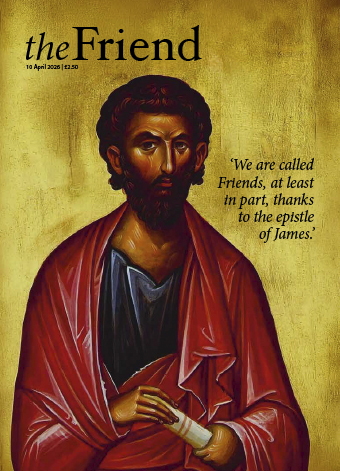
The Friend is a weekly magazine in which Friends speak to each other and to the wider world, offering their insight, ideas, news, nurture and inspiration.
Nurturing Quaker community, each issue offers a space for Friends to share their concerns, and to support each other in faith and witness.
The Friend: enriching, inspiring and connecting the Quaker community since 1843.

As I have sought to address Quaker conflicts over the years, I have often been drawn to Isaac Penington’s letter to Amersham Friends. You’ll probably know the key line from it, as it appears in Quaker faith & practice (10.01): ‘Our life is love, and peace, and tenderness; and bearing one with another, and forgiving one another, and not laying accusations one against another; but praying one for another, and helping one another up with a tender hand.’

On 13 April I’m looking forward to speaking on the BBC about the epistle of James. It’s a little-known book, disliked by some because its words disrupt some aspects of Christian dogma. But it is liked by many Quakers, especially as James says that faith is meaningless without deeds, and that what we do is more important than what we say. He also calls for peace and equality. An elder I knew used to call it ‘the Quaker book’ because of its resonances with our faith. Since then I’ve been amazed to discover just how many well-loved lines from early Friends have a link with the epistle. To be radical means to ‘go to the root’. So here are six radical roots of well-known Quaker phrases that have a connection with James.

Rene Girard (1923–2015) was a multidisciplinary French academic with an interest in theology. He has been praised for his contribution to our understanding of the root cause of violence in society, namely the scapegoat mechanism and the significance of the empty tomb in the Easter narrative. He began by examining ancient cultures through their mythologies, distinguishing between a common understanding of a ‘myth’ as ‘untrue’, and its root meaning ‘mute’– containing profound hidden truths. In Greco-Roman literature, he found examples of violence based on rivalry, in the foundation of civilisation.

There is a curious device in the far east known as the monkey trap. Made out of clay, it is a round bulbous jar with a long thin neck. Some sweets are placed in the bottom of the jar, and it is tied to a tree. A monkey comes along and, seeing the sweets, reaches down to get them. The problem is that the neck of the jar is too narrow to allow the monkey to withdraw its fist. An inability to let go keeps the monkey trapped.

Did you read Lord of the Flies when you were at school? If so, you may have seen it as a dystopian tale of boys unsupervised on a deserted island who end up killing each other. The story has been adapted for a BBC TV series (currently on iPlayer) by screenwriter Jack Thorne. Thorne has become well known for his Netflix series Adolescence, which provoked searching conversations about toxic masculinity.







Become a subscriber to enjoy unlimited access to our articles, dating back to 2009! Online subscribers get the Friend to their inbox each week, can comment on articles, and dive into our 1914-18 digital archive too!
Whether you are new to Quakerism or have been going to Meeting for years, you’ll find something here to inspire, inform and challenge you.
News | Views | Reviews
Written by and for Friends on the bench
Subscribe